01
The brief
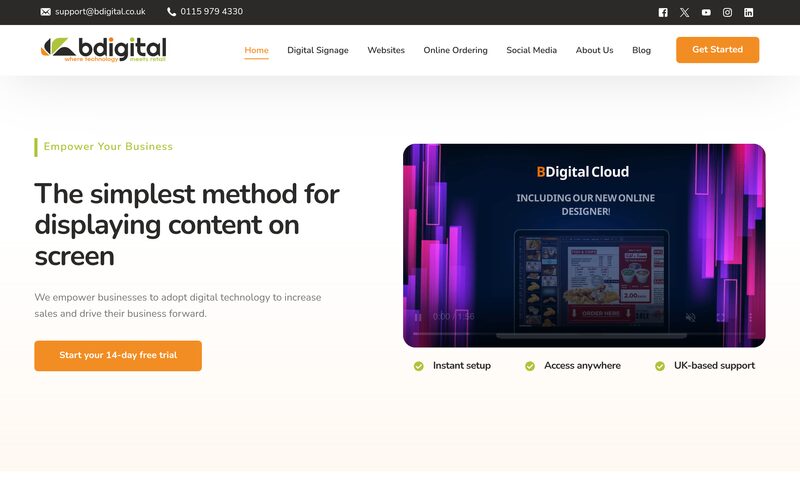
BDigital sells digital signage to businesses whose screens live in the real world: the menu board above the counter in a fish and chip shop, the window display in an estate agent, the price list in a salon. Their customers are not IT departments. They are owners who want the screen to show the right thing and otherwise never think about it.
The important part of the brief was that BDigital did not want to resell somebody else's signage platform. The product was going to be theirs, which meant the whole thing had to be built: the software on the screen, the software the customer uses to drive it, and the billing that turns it into a subscription business. Every piece of what follows was written bespoke for them.
02
The player: the part that is not allowed to fail
The player is the app that actually runs on the screen, on Android and on other operating systems depending on what the customer has mounted on the wall. It is the least glamorous part of a signage platform and by far the most important, because it is the only part that is unattended.
That drives every decision about it. It has to come back on its own after a power cut, because nobody is going to climb over a fryer to restart a screen. It has to keep playing from what it already holds when the shop's wifi drops, because a blank screen during a lunchtime rush is the whole product failing in public. And it has to update and recover remotely, because the alternative is an engineer in a van for something that should be a background task.
Building for several operating systems rather than one is a deliberate cost. It means BDigital are not tied to a single hardware supplier, and a customer who already has screens is not told to replace them before they can buy anything.
03
The customer app, and two designers
The customer app is where a business manages its screens: what is playing, where, when, and on which of them. A customer with six screens across two sites should be able to change one of them without touching the other five, and should be able to see at a glance whether they are all actually online.
Alongside it we built a full screen designer, so customers can lay out their own content rather than sending artwork to somebody and waiting. The design constraint there is unusual and worth stating plainly: the person using it runs a takeaway, not a design studio. It has to be hard to produce something that looks bad, which is a different and much harder problem than giving somebody a blank canvas and every option.
The second designer covers social media. It exists because the same owner who has just built a menu board wants that promotion on Facebook and Instagram too, and doing it twice in two different tools is where good intentions die. Same content, same brand, different output shape.
04
Billing on two rails: Stripe and GoCardless
BDigital sell per screen on a monthly subscription, publicly at £9.99 a screen with a free trial and no tie-in. That pricing model is simple to advertise and unforgiving to implement: the bill has to follow the screen count as customers add and remove screens, and adding a screen has to be something a customer does themselves at eleven at night without anybody at BDigital being involved.
Payments run through both Stripe and GoCardless, and that is not belt and braces. Stripe takes cards, which is what people expect at sign-up. GoCardless takes Direct Debit, which is what UK small businesses actually prefer for a recurring monthly bill, and which does not quietly fail eighteen months later when a card expires. For a subscription product, cards silently expiring is one of the largest sources of customers you lose without ever being told.
05
Where it is now
The platform is live and sold nationwide, and we continue to host, support and extend it. Hosting a product that other businesses depend on for their shop front is a different commitment from hosting a brochure site: when something goes wrong it is not one company's website that is affected, it is every screen running on the platform.
That is the argument for the people who built it being the people who run it. A change request goes to somebody who already knows why the player caches what it caches, and why the billing is on two rails.